
Choosing a warehouse structure will come down to three practical questions. How quickly can it be built? What will it cost? And will it continue performing after years of heavy industrial use?
Both steel and concrete will create strong and durable warehouse structures. But they perform differently in terms of construction speed. Fire resistance. Maintenance and future expansion. So the right answer will depend less on which material looks stronger. Also more on what your operation actually needs.
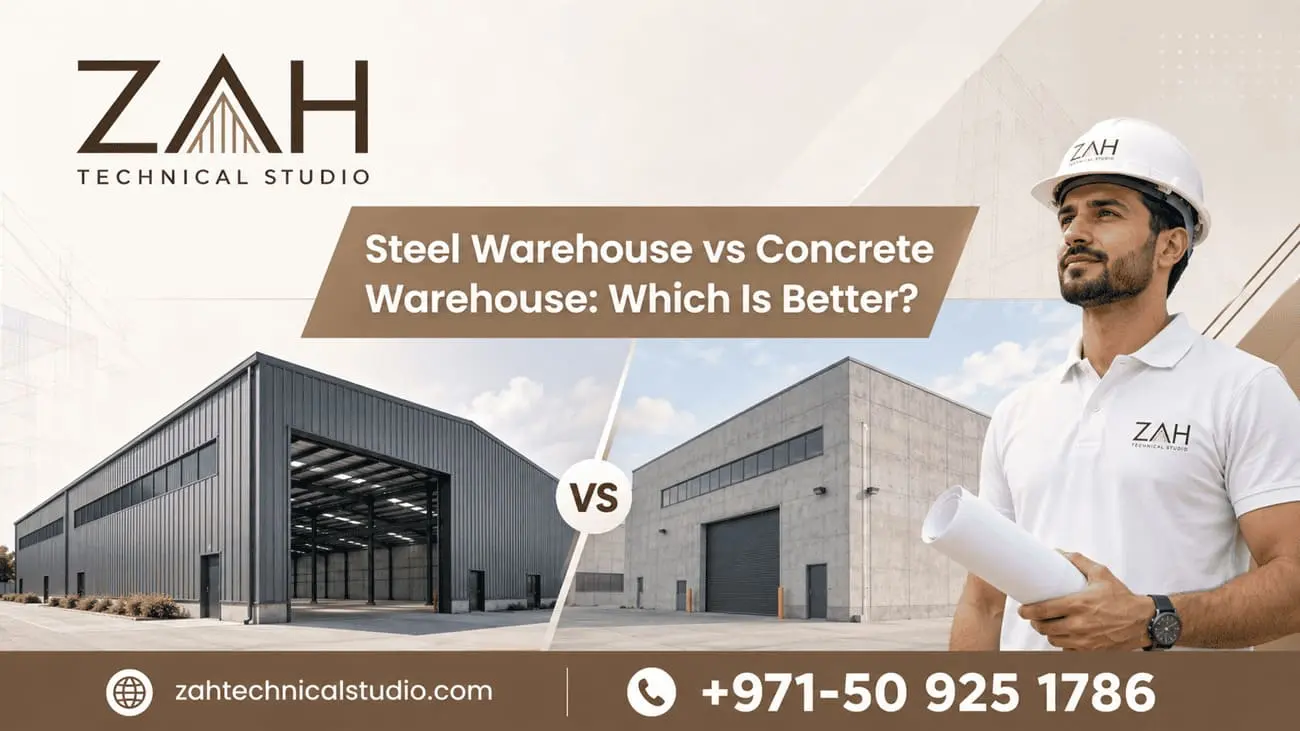
What Is a Steel Warehouse?
A steel warehouse uses structural steel columns. Beams and roof framing to form the main building skeleton. Contractors will fabricate many components away from the site. Before transporting them for assembly.
A prefab steel warehouse will work particularly well for distribution centres. Factories. Workshops. Cold stores and logistics facilities. Steel will create wide and column-free spaces. That supports racking systems. Forklifts. Also changing production layouts. Get details on Warehouse Setup in Dubai.
What Is a Concrete Warehouse?
A concrete warehouse will rely on reinforced concrete columns. Walls. Beams. Or precast structural elements. Concrete will provide substantial mass. Impact resistance. Also strong fire performance.
For instance, operators often choose concrete for facilities that require heavy-duty walls, high security, controlled internal temperatures or added resistance against daily mechanical impact. But concrete construction will generally require more site preparation. Curing and foundation work.
Cost Comparison: Steel vs Concrete
The final warehouse construction cost will depend on floor area. Soil conditions. Structural load. Insulation. Fire systems. MEP services and authority requirements. Therefore, no contractor should compare prices using the structural frame alone.
|
Comparison factor |
Steel warehouse |
Concrete warehouse |
|
Indicative structural cost index |
100 baseline |
110–140 |
|
Typical low-rise build period |
12–20 weeks |
20–36 weeks |
|
Common design-life expectation |
40–60+ years |
50–100+ years |
|
Foundation demand |
Usually lighter |
Usually heavier |
|
Future extension |
Relatively straightforward |
More complex |
|
Maintenance focus |
Coatings, corrosion and joints |
Cracks, joints and water ingress |
These figures provide early planning guidance rather than a fixed quotation. Project scale, design loads, specifications and local approvals can change the final programme and cost.
Steel often reduces foundation and labour requirements because its structural frame weighs considerably less than an equivalent concrete structure. As a result, it may provide better value for large, single-storey industrial buildings. Looking for a Villa Interiors Service in Dubai?
Construction Speed and Timeline
Steel normally wins when speed drives the decision. Fabricators can manufacture components. While the contractor prepares foundations. Also utilities on-site. Afterwards, the erection team bolts the frame together in a planned sequence.
Concrete work will involve formwork. Reinforcement. Pouring and curing. Precast concrete will shorten the schedule. Transportation, lifting and connection work will require careful coordination.
Durability and Lifespan
Both systems will last for decades. When engineers design them correctly. Concrete will handle moisture. Impact and severe weather well. While steel will provide excellent strength. Without creating excessively heavy foundations.
But coastal air, chemicals and humidity. This will corrode unprotected steel. Concrete can face risks. This includes cracking. Reinforcement corrosion and joint deterioration. Detailing and workmanship will matter as much as the chosen material.
Concrete buildings will remain useful. Beyond their original 50- or 60-year design life. Particularly when owners can maintain and adapt the structure properly.
Maintenance Requirements
A steel structure will need periodic inspections for damaged paint. Corrosion. Roof fasteners and water entry. Contractors will usually access and repair these areas. Without major structural demolition.
Concrete needs less surface coating. Although owners must monitor cracks. Movement joints and exposed reinforcement. Delayed repairs will allow moisture to penetrate deeper into the structure. Get details on Aluminium Fabrication Service in Dubai.
Fire Resistance and Safety
Concrete does not burn. Naturally slows heat transfer. It can provide strong built-in fire resistance. Without relying heavily on additional protective coatings.
Steel can remain non-combustible. But high temperatures will reduce its structural strength. So engineers will specify intumescent paint. Fireproof boards. Or spray-applied protection. Where regulations can demand a rated system.
Environmental Impact and Sustainability
Steel supports circular construction. Because crews can dismantle. Reuse and recycle many structural components. Prefabrication will produce little site waste. Also steel can be recycled repeatedly.
Concrete has a larger material mass. Yet its durability and thermal mass will lower long-term repair. Also cooling demands. The most sustainable solution will depend on material sourcing. Transport. Energy performance. Lifespan and future adaptability.
Customisation and Design Flexibility
Steel will offer greater flexibility. For long spans. Mezzanine floors. Cranes. Extra loading bays and future extensions. Therefore, businesses expecting operational growth often prefer it.
Concrete provides excellent solidity but makes later structural alterations more difficult. Cutting new openings or extending reinforced concrete may require detailed surveys, strengthening and heavier equipment.
Related Services:
» Office Interior Service in Dubai
» Tiling and Ceiling Service in Dubai
» frameless glass work in sharjah
» plumbing contracting in dubai
Which One Should You Choose?
Choose a steel warehouse when you need:
- Faster construction and earlier occupancy
- Large, open storage or production areas
- Easier future expansion
- A lighter structure on suitable foundations
- Flexible industrial layouts
Choose a concrete warehouse when you need:
- Strong inherent fire resistance
- High impact or security performance
- Greater structural mass
- Long-term temperature stability
- A permanent facility with limited future alteration
A hybrid approach will work best. A developer can combine a steel frame and roof with reinforced concrete flooring. Retaining walls. Fire compartments and loading areas.
Related Articles:
» Custom Furniture vs Ready-Made Furniture: Which Is Better?
» Benefits of Steel Structure Warehouses in Dubai
» How Long Does It Take to Build a Warehouse in Dubai?
» Office Glass Partitions Cost in Dubai
» Best Flooring for a Dubai Warehouse
Build the Right Warehouse with ZAH Technical Studio
The debate around steel vs concrete buildings has no universal winner. Steel leads in speed. Flexibility and expansion potential. Whereas concrete can perform strongly in fire resistance. Solidity. Also long-term durability.
ZAH Technical Studio will evaluate your site. Operating requirements. Budget and approval needs. Before recommending a structural solution. Speak with our experienced warehouse construction company. To plan efficiently and compliant. Also a practical facility that supports your business for years.
FAQs: Steel Warehouse vs Concrete Warehouse
A steel warehouse is cheaper for large and low-rise industrial projects. Because it requires less structural material. Lighter foundations and fewer on-site labour hours. But fireproofing and insulation. Specialist coatings and fluctuating steel prices. This will affect the total warehouse construction cost. Always compare complete project quotations rather than frame prices.
A prefab steel warehouse will normally take less time to construct. Because the manufacturer will produce beams and columns away. From the building site. Contractors will complete foundations and utilities. Concrete construction will usually take longer. Due to reinforcement installation. Formwork. Pouring. Curing. Also weather-dependent on-site activities.
Both steel and concrete warehouses. This can last for decades. With proper design and maintenance. Concrete will offer a longer theoretical service life. While steel structures will remain highly durable. When protected against moisture and corrosion. Local climate. Material quality. Drainage. Workmanship and maintenance. This ultimately determines the building’s actual lifespan.
Steel is suitable for warehouses in hot climates. When the design includes effective insulation. Reflective roofing. Ventilation and thermal breaks. Without these measures. The building will absorb and transfer excessive heat. So climate-responsive roofing and cooling design will matter more. Than the steel frame itself.
Concrete will generally provide better inherent fire resistance. Because it does not burn and transfers heat slowly. Steel does not contribute fuel to a fire. But it loses strength as temperatures rise. A steel warehouse will require protective boards. Coatings or sprays. To meet the required fire rating.
A steel warehouse requires planned rather than constant maintenance. Owners must inspect protective coatings. Bolts. Roof sheets. Gutters. Seals and areas exposed to moisture. Or chemicals. Promptly repairing scratches. Also leaks help prevent corrosion. With a sensible inspection schedule. Steel maintenance will remain predictable. Also manageable.
A concrete warehouse will need inspections for cracks. Leaking joints. Surface damage. Settlement and exposed reinforcement. Although concrete will need fewer protective coatings. Ignored cracks will allow water and chemicals to reach the reinforcement. Early sealing and repairs will help preserve structural performance. While controlling long-term maintenance costs.
Steel will provide better design flexibility. For most warehouses. Because it can create wide spans. With fewer internal columns. It can support mezzanines. Cranes. Canopies and future extensions. Concrete will provide flexible layouts. Although later openings. Structural changes and extensions. This will usually require more demolition and engineering work.
A steel warehouse will work best for logistics operations. Because it offers fast construction. Large clear spans. Also easier expansion. These features will support pallet racking. Loading bays and material handling systems. But designers will still use concrete for floors. Dock areas. Fire walls and sections. Exposed to frequent vehicle impact.
Yes. Steel and concrete will commonly work together. In modern industrial building construction. A project will use steel columns. Also roof framing with reinforced concrete foundations. Floors. Loading docks and fire-resistant walls. This hybrid solution will combine steel’s flexibility. Also speed with concrete’s mass. Impact resistance and fire performance.
A well maintained steel warehouse. This will attract buyers who value flexible layouts. Easy expansion. Also straightforward internal modifications. A concrete warehouse will appeal to businesses seeking permanence. Security and strong fire resistance. Resale value will depend mainly on location. Approvals. Access. Clear height. Condition and operational suitability.
Choose a warehouse construction company. With proven industrial experience. Transparent costing. Also knowledge of local approval procedures. The contractor must assess soil conditions. Loading requirements. Fire safety. MEP services and future expansion plans. Request a detailed scope. So you can compare specifications. Rather than headline prices alone.